Screen Verdict review
Shōgun season one review: Power across languages
A disciplined first season in which translation, protocol and partial knowledge become instruments of political power.
Five-part assessment
Score breakdown
- Story
9.2 out of 10 9.2 - Acting
9.5 out of 10 9.5 - Direction
9.5 out of 10 9.5 - Visuals
9.7 out of 10 9.7 - Music
9.1 out of 10 9.1
Spoiler-free review
The verdict in full
Power across languages
The first season of Shōgun is organized by partial knowledge. Political power depends on what can be understood, translated or deliberately left uncertain. Language becomes action: interpretation creates access, delays conflict and changes what another person is permitted to know. The season’s scale matters because it makes attention—not size alone—the route through a complicated political landscape.
The Shōgun title page records its starting point in Japan in 1600, where a stranded English pilot becomes entangled in a powerful lord’s struggle and the work of a multilingual noblewoman. This review is limited to the ten released episodes of the 2024 first season. It offers no judgment about announced or unreleased later seasons.
Story and themes
Political complexity grows from competing obligations and imperfect information rather than a parade of names. Translation, loyalty, faith, social role and the cost of being useful to power emerge through specific relationships. The story does not ask one outsider’s confusion to stand for the whole world. Instead, his assumptions are corrected, limited and displaced as other perspectives gain weight.
The multilingual noblewoman is never merely an explanatory bridge. Language is both skill and burden, creating agency while making her responsible for meanings she does not control. The lord’s strategy becomes legible through patience without surrendering every piece of information. That balance turns protocol into suspense.
Across ten episodes, ceremony, conversation and consequence reinforce one another. Quiet passages create pressure because social rules shape what can be said openly, while sudden action grows from established stakes. Dense early exposition requires close attention, and the solemn presentation can create emotional distance. Even so, the season rewards attention rather than demanding specialist preparation. More stories shaped by institutional pressure appear in Screen Verdict’s drama collection.
Performances
Hiroyuki Sanada communicates authority when strategy cannot be spoken directly. Anna Sawai makes translation an interior conflict rather than a display of fluency, preserving personal intention inside duty. Cosmo Jarvis allows force, confusion and adaptation to change without making the outsider the default measure of every encounter. Tadanobu Asano contributes an unpredictable tonal energy that keeps political calculation from becoming uniformly solemn.
Listening is as important as declaration. Reactions move through two languages and several levels of rank, so a pause can reveal who understood a statement, who understood its implication and who must pretend otherwise. The ensemble’s command of those layers earns a 9.5 acting score.
Direction and craft
Scale clarifies power. Large settings, formal movement and crowds matter because the viewer can read who controls a space and why a change in position carries risk. Conversations involving interpretation hold multiple levels of attention at once: the original statement, its rendering and the reactions around it. Suspense often comes from protocol rather than chase mechanics.
The season maintains impressive visual and tonal consistency across its episodes. Deliberate pacing usually sharpens political pressure, though solemnity occasionally keeps emotion at a distance. The direction is most effective when material richness reveals relationships and institutions instead of asking production value to carry meaning by itself. Readers can explore more period-centered work through the historical catalogue.
Visuals and music
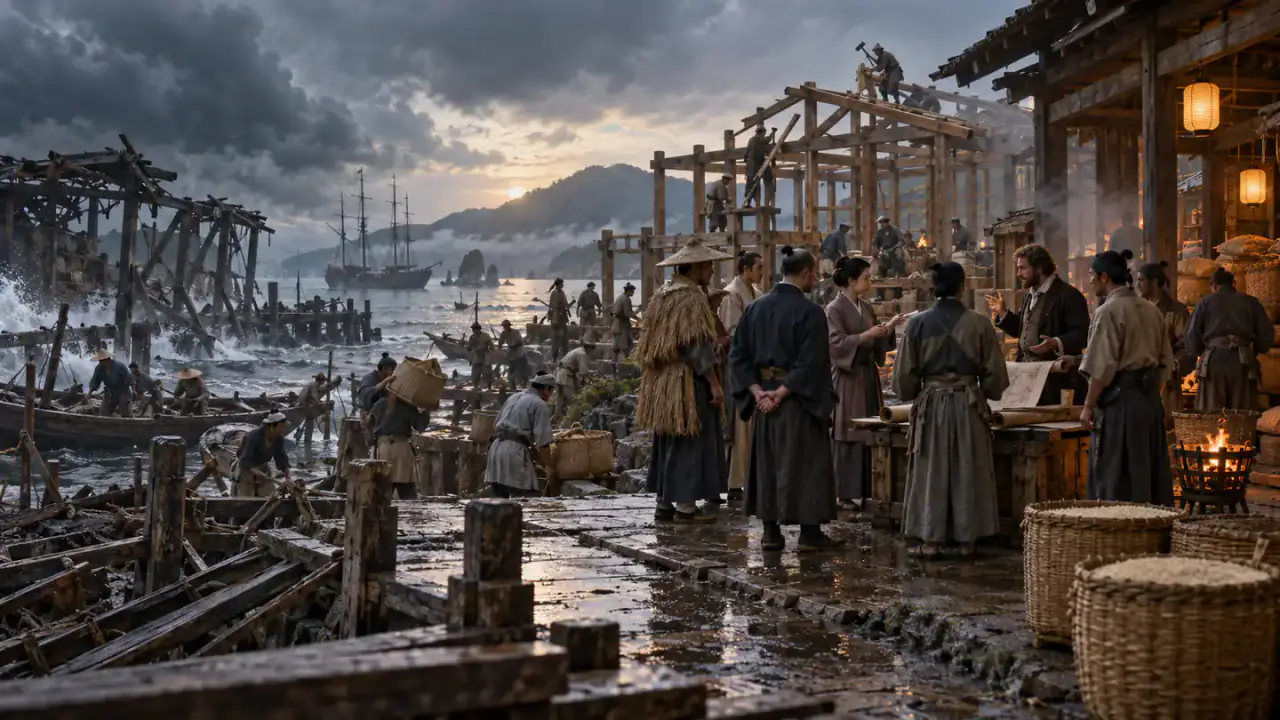
Landscapes, interiors, costume and weather function as dramatic information. Distance, barriers and formal arrangement express access or isolation; beauty rarely arrives without a social meaning. The 9.7 visual score evaluates coherence and expressive purpose rather than claiming specialist authority over historical reconstruction.
Music and sound support tension across languages and environments. Percussion, sustained tones, silence and natural sound carry transitions without turning cultural difference into generic exoticism. The score remains slightly below the visual and performance marks because restraint and integration, rather than melodic dominance, are its central virtues.
Audience and content guidance
Season one suits viewers who welcome subtitles, patient historical drama, political negotiation and ensemble storytelling. It is less suitable for anyone seeking continuous action or wishing to avoid strong violence, injury detail, suicide-related material, sexual content, language and sustained threat. No global age classification is asserted; viewers should consult current guidance for their own region.
The complete Screen Verdict review archive contains further spoiler-free criticism. Shōgun season one earns 9.3/10 as a disciplined drama about power exercised through language, patience and constrained perspective. That rating applies only to its ten released first-season episodes.
Strengths
- A multilingual dramatic structure
- Patient ensemble performances
- Spatially legible direction
- Images that connect ceremony to power
Weaknesses
- Dense early exposition requires close attention
- The solemn presentation can sometimes create emotional distance
Audience fit
Who should watch it?
Viewers who welcome patient historical drama, subtitles, political negotiation and ensemble storytelling across a complete first season.
Trailer policy
Trailer unavailable
No verified official trailer is linked, embedded or set to autoplay.
Continue exploring